Hello and welcome to my ongoing video course about Tensor Analysis, already consisting of 12 videos. This series explores important topics in a structured order and is still in production, with more videos to be added in the future. Along with the videos, you’ll find helpful text explanations. You can test your knowledge using the quizzes and refer to the PDF versions of the lessons as needed. If you have any questions, feel free to ask in the community forum. Let’s dive in!
Part 1 - Introduction
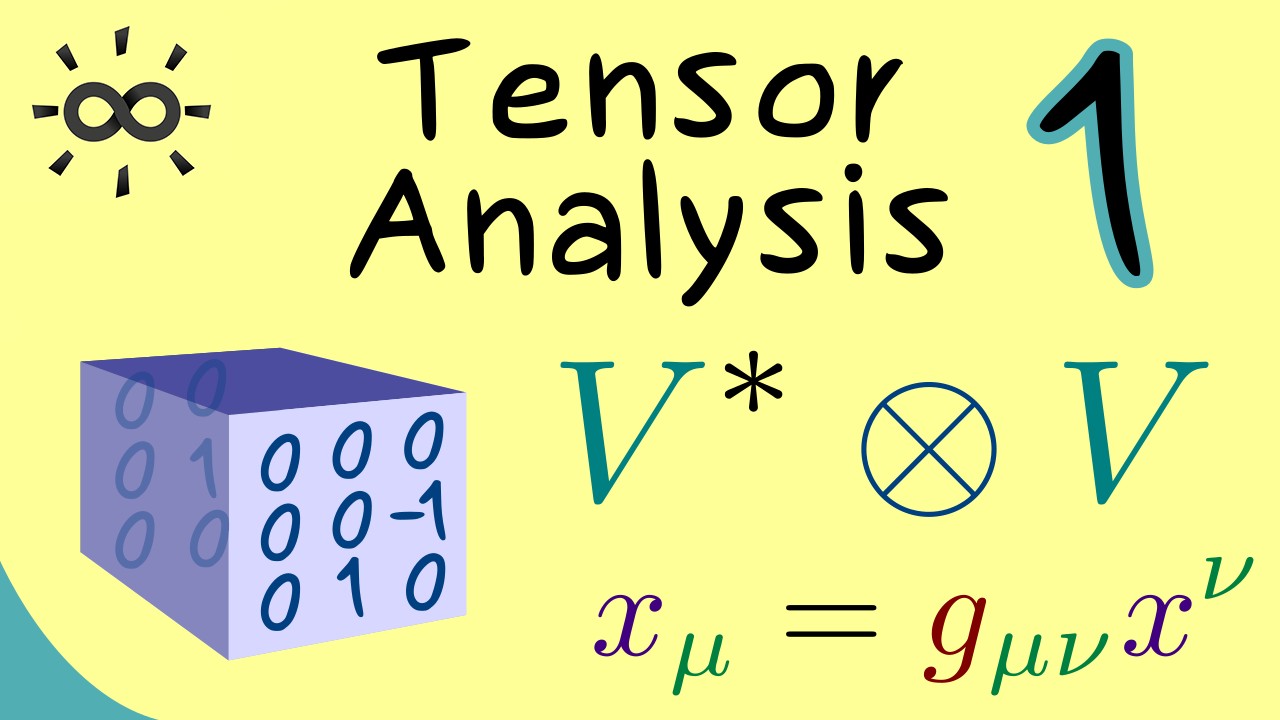
In the first part I want to talk about the prerequisites you will need to understand this series and the content you can expect here. Since we are dealing with multilinear maps, a solid knowledge of Linear Algebra is beneficial. Later on, some knowledge about manifolds can also help, but this is something I will point out in later videos. First we will start with purely algebraic descriptions of maps, tensors, tensor products, dual spaces and so on. To get everything started, we will look at the Levi-Civita tensor.
Part 2 - Multilinear Maps
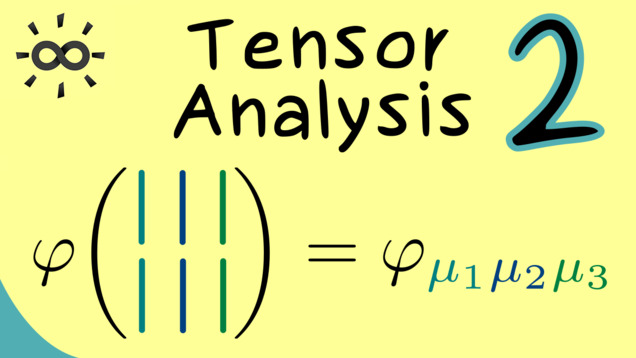
Now we ready to dive into Multilinear Algebra, which is something is something you might have already seen in my Linear Algebra course. For example, the determinant is a really useful multilinear map. Especially for this example, we can write down the components of this map with respect to a given basis.
Part 3 - Tensor Product
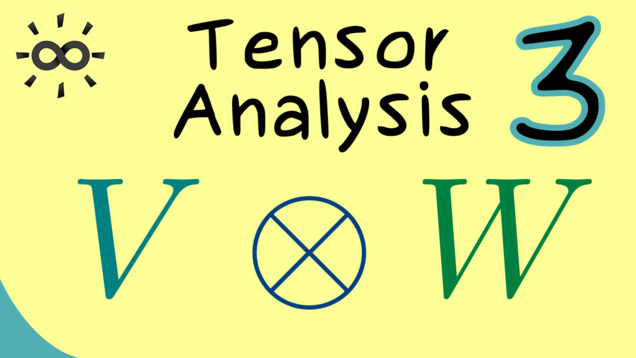
The tensor product is a useful tool that is defined and used in a lot of different parts of mathematics. The definition changes a little bit, depending which structures you want to conserve. Here, we can keep it quite simple because we only have the vector space structure and we can even restrict ourselves to finite-dimensional vector spaces. It turns out that the tensor product can be constructed by using bases, but that the defining properties can be summarized in one universal property.
Part 4 - Dual Space
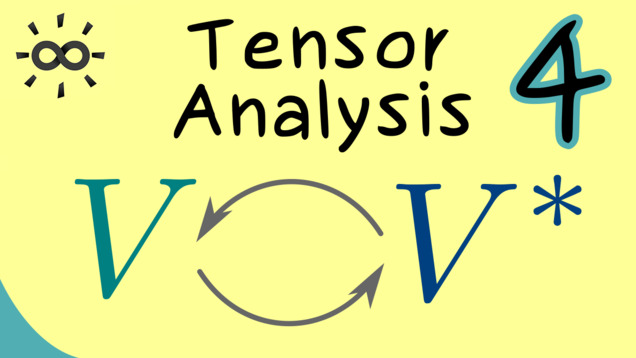
The dual space can be defined in a purely algebraic sense, which means that $V^\ast$ consists of all possible linear functionals defined on $V$. The important thing for us is that every basis in $V$ has a corresponding basis in $V^\ast$ called the dual basis.
Part 5 - Contravariant Components of Vectors
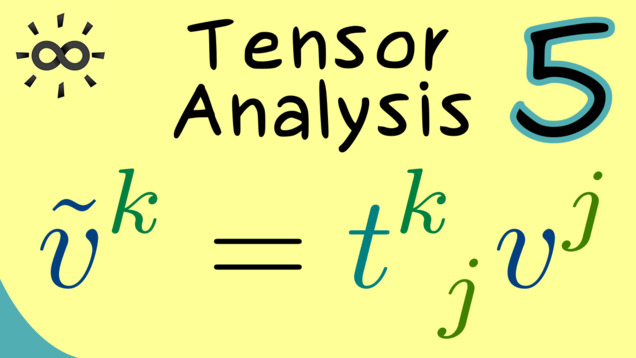
The term contravariant is kind of old-fashioned but still used in Tensor Analysis, especially in applications from physics. Let’s just explain what it actually means by looking at the components of a vector and how they transform under a change of basis.
Part 6 - Covariant Components of Vectors
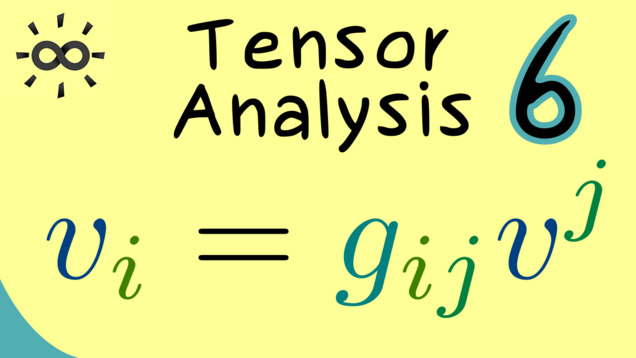
Next to the term contravariant, we also find the term covariant in Tensor Analysis. It’s also old-fashioned but still used a lot in applications. It describes the opposite transformation behaviour for coordinates and we can simply describe that for a vector space with an inner product. More generally, it’s enough to take a non-degenerate symmetric bilinear form on the vector space. Because in this case, the vector space is canonically isomorphic to its dual space. So we can completely identify elements in $V$ with elements in $V^\ast$, and the latter ones will have covariant components.
Other videos related to this topic:
Part 7 - Covariant Tensors
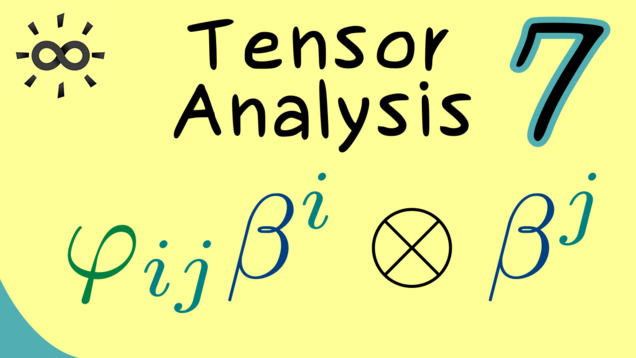
Now we ready to give the formal definition of a tensor. Let’s start with so-called covariant tensors because they are easier to define as multilinear forms. In a more modern language, we would call these tensors of type (0,k) if we a $k$-linear form. Moreover, we also able to identify multilinear maps with elements from a tensor product. This is the common representation of tensors we will use troughout this course.
Part 8 - Tensors of Type (p,q)
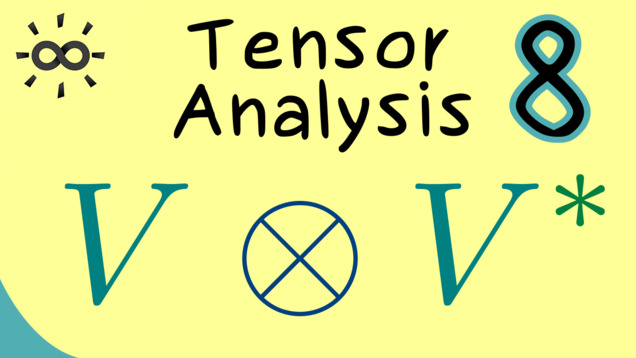
Now we can go the general definition of a tensor. More precisely, we will talk about $q$ times covariant and $p$ times contravariant tensors, which can be defined a multilinear form. In the domain of definition we find the vector space $V$ and its dual space $V^\ast$. Depending how ofter they occur, we get the numbers $p$ and $q$. In fact, the more modern name for such a tensor would be just a tensor of Type (p,q) and we can also identify this one with an element in a special tensor product space. For that, we first have to talk about the bidual space of a vector space.
Part 9 - Trace and Contraction
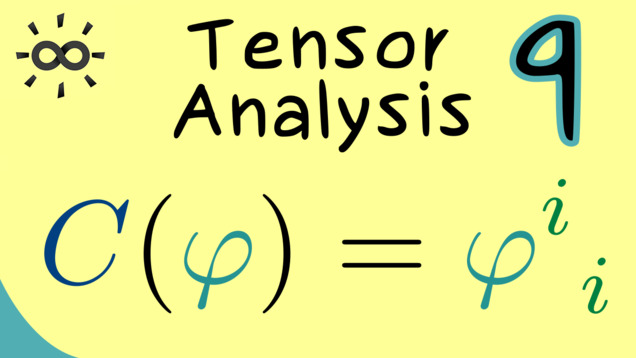
Let’s first discuss which tensors are canonically identified with linear maps. Afterwards, we can discuss the general concept of the trace of such a linear map, which can be defined as the sum of the diagonal elements of a matrix representation. However, now we also have the tools to give a basis-free definition. This one immediately leads us to the general definition for tensors, usually called contraction.
Other videos related to this topic:
Part 10 - Outer Product of Tensors
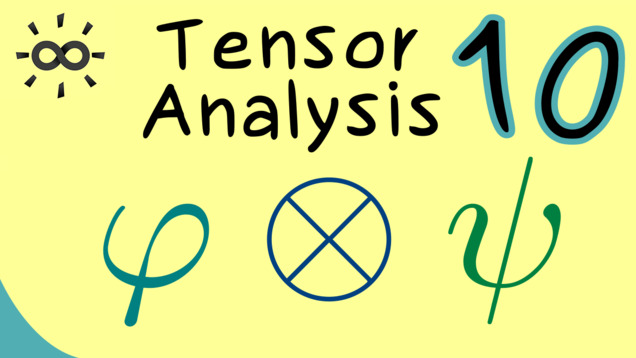
We already know the tensor product for the construction of a new vector space and for the definition of tensors as elements. Now we want to extend it and see it as an operation between different tensors. Therefore, the name outer product is quite fitting, but beware that the name is used for a lot of other operations as well. The definition for multilinear maps is really natural. However, there are some technical details if we want to use it for tensors of type (p,q).
Part 11 - Tensor Fields
After discussing in detail what a tensor actually is, we can extend to notion to a tensor field. It short, it’s just a tensor assigned to every point in space. What mean by space can differ but in in general we will consider smooth manifolds.

Other videos related to this topic:
Part 12 - Metric Tensor
In this video, we generalize the concept of a Riemannian manifold to something we will call a pseudo-Riemannian manifold. Essentially, it’s just a smooth manifold together with a special tensor field of type $(0,2)$, which we will call the metric tensor. The name comes from the fact that is puts a geometry to each tangent space. It’s almost an inner product but we don’t require the positive definiteness but just nondegeneracy.

At the moment, this was the last video in the series but not the last video about the topic of Tensor Analysis. We continue developing the whole series soon.
Connections to other courses
Summary of the course Tensor Analysis
-
You can download the whole PDF here and the whole dark PDF.
-
You can download the whole printable PDF here.
- Ask your questions in the community forum about Tensor Analysis.
Ad-free version available:
Click to watch the series on Vimeo.