-
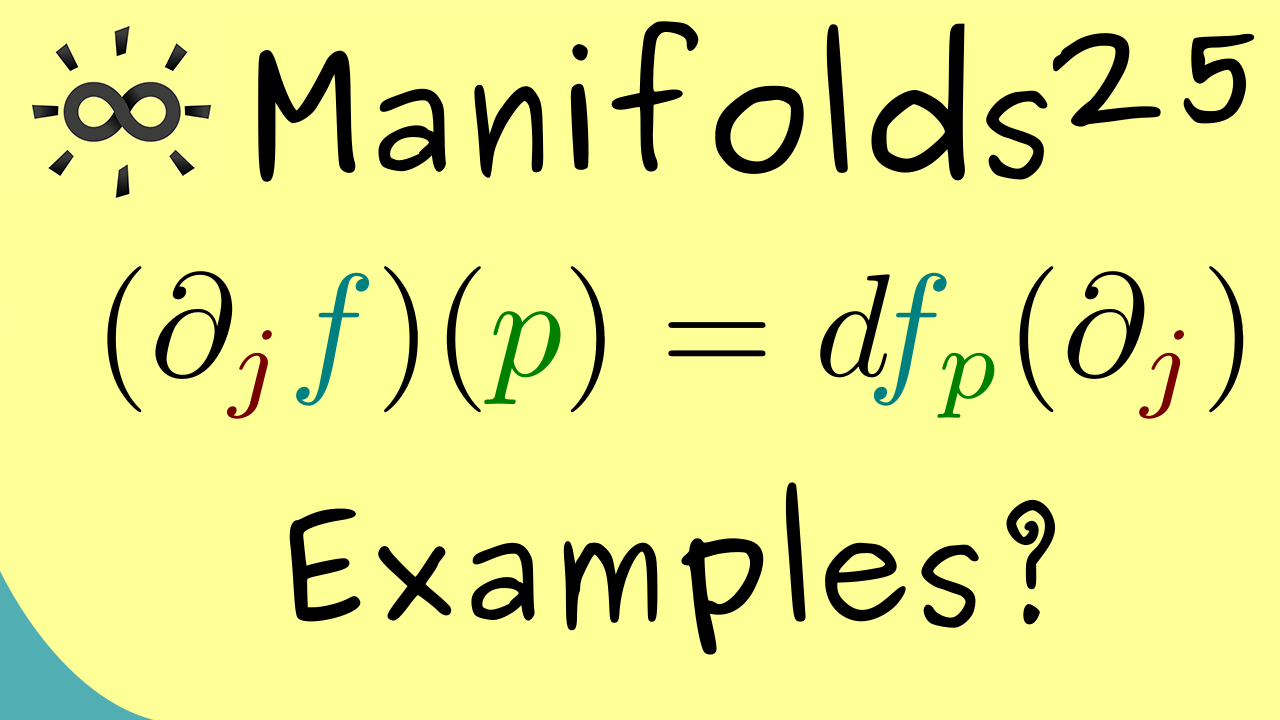
Title: Differential (Example)
-
Series: Manifolds
-
Chapter: Differential Calculus
-
YouTube-Title: Manifolds 25 | Differential (Example)
-
Bright video: Watch on YouTube
-
Dark video: Watch on YouTube
-
Ad-free video: Watch Vimeo video
-
Original video for YT-Members (bright): Watch on YouTube
-
Original video for YT-Members (dark): Watch on YouTube
-
Forum: Ask a question in Mattermost
-
Quiz: Test your knowledge
-
Dark-PDF: Download PDF version of the dark video
-
Print-PDF: Download printable PDF version
-
Thumbnail (bright): Download PNG
-
Thumbnail (dark): Download PNG
-
Subtitle on GitHub: mf25_sub_eng.srt missing
-
Download bright video: Link on Vimeo
-
Download dark video: Link on Vimeo
-
Timestamps (n/a)
-
Subtitle in English (n/a)
-
Quiz Content
Q1: Let $M$ be a smooth manifold with chart $(U,h)$ and $p \in U$. What is definition of the tangent vector $\partial_j \in T_p(M)$?
A1: $ \partial_j = d(h^{-1})_{h(p)}(e_j) $ where $e_j$ is the canonical unit vector in $\mathbb{R}^n$.
A2: $ \partial_j = dh_{h(p)}(e_j) $ where $e_j$ is the canonical unit vector in $\mathbb{R}^n$.
A3: $ \partial_j = dh_{h^{-1}(p)}(e_j) $ where $e_j$ is the canonical unit vector in $\mathbb{R}^n$.
A4: $ \partial_j = h^{-1}(e_j) $ where $e_j$ is the canonical unit vector in $\mathbb{R}^n$.
Q2: Let $M$ be a smooth manifold with chart $(U,h)$ and $p \in U$. What is not correct for the directional derivative of a smooth function $f: M \rightarrow \mathbb{R}$?
A1: $ (\partial_j f)(p) = dh(e_j)$ where $e_j$ is the canonical unit vector in $\mathbb{R}^n$.
A2: $ (\partial_j f)(p) = df_p(\partial_j) $
A3: $ (\partial_j f)(p) = J_{f \circ h^{-1}}( h(p) ) e_j $ where $e_j$ is the canonical unit vector in $\mathbb{R}^n$.
A4: $ (\partial_j f)(p) = \frac{\partial( f \circ h^{-1} ) }{\partial x_j} (h(p)) $
Q3: Let $M$ be an open set in $\mathbb{R}^n$, so a simple $n$-dimensional manifold where $h=\mathrm{id}$ can be chosen as a chart. What is correct for the directional derivative of a smooth function $f: M \rightarrow \mathbb{R}$?
A1: $ \partial_j f= \frac{\partial f }{\partial x_j}$
A2: $ \partial_j f= 1$
A3: $ \partial_j f= 0$
A4: $ \partial_j f= \mathrm{id}$
-
Last update: 2025-09