-
Title: Hausdorff Spaces
-
Series: Manifolds
-
Chapter: Topology
-
YouTube-Title: Manifolds 3 | Hausdorff Spaces
-
Bright video: Watch on YouTube
-
Dark video: Watch on YouTube
-
Ad-free video: Watch Vimeo video
-
Original video for YT-Members (bright): Watch on YouTube
-
Original video for YT-Members (dark): Watch on YouTube
-
Forum: Ask a question in Mattermost
-
Quiz: Test your knowledge
-
Dark-PDF: Download PDF version of the dark video
-
Print-PDF: Download printable PDF version
-
Exercise Download PDF sheets
-
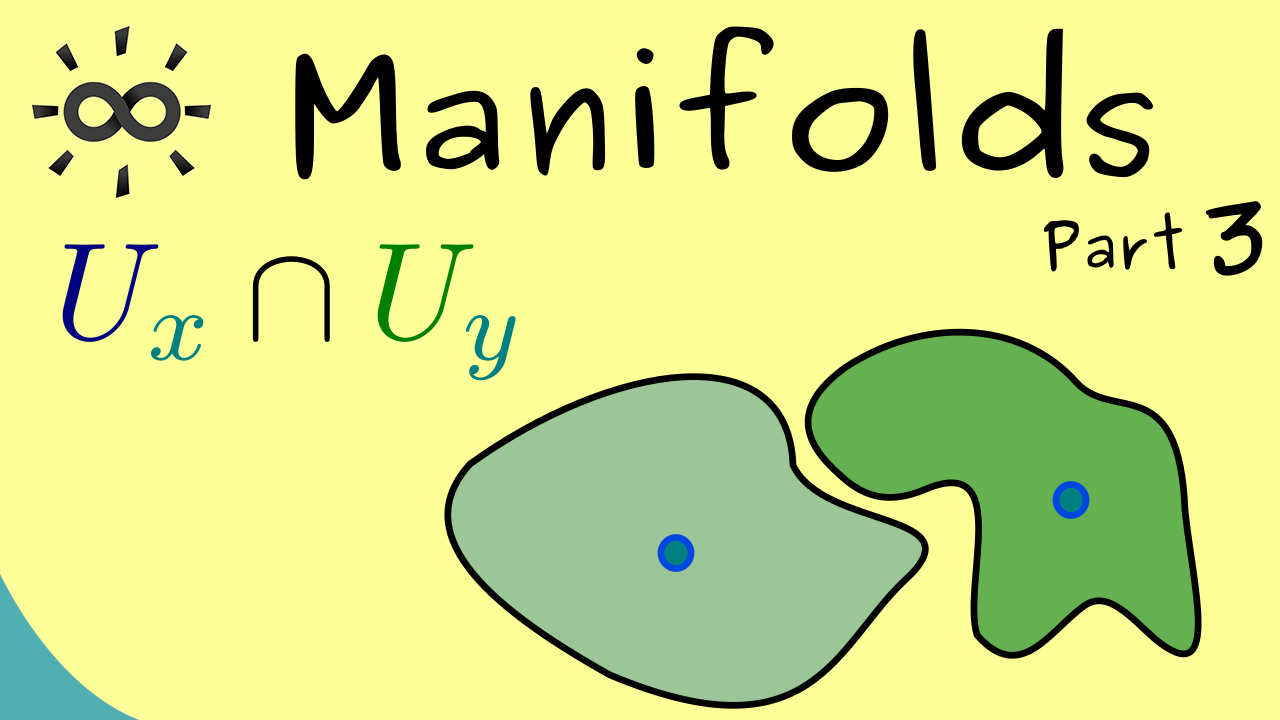
Thumbnail (bright): Download PNG
-
Thumbnail (dark): Download PNG
-
Subtitle on GitHub: mf03_sub_eng.srt
-
Download bright video: Link on Vimeo
-
Download dark video: Link on Vimeo
-
Other languages: German version
-
Definitions in the video: convergence in topological space, Hausdorff space, open neighbourhood, convergence in a topological space, Hausdorff space
-
Timestamps
00:00 Introduction
00:25 Convergence in metric spaces
03:07 Convergence in topological spaces
03:59 Definition: convergence and limit
05:20 Example of non-unique limit
07:34 Definition: Hausdorff space
08:54 Credits
-
Subtitle in English
1 00:00:00.865 –> 00:00:03.375 Hello and welcome back to Manifolds
2 00:00:04.115 –> 00:00:06.855 and first, as always, I want to thank all the nice people
3 00:00:06.915 –> 00:00:10.335 who support the channel Steady, via PayPal or by other means.
4 00:00:11.355 –> 00:00:12.735 Now, in today’s part three,
5 00:00:12.835 –> 00:00:15.895 we will talk about special topological spaces, namely,
6 00:00:15.895 –> 00:00:17.535 so-called Hausdorff Spaces.
7 00:00:18.695 –> 00:00:22.035 Indeed, these Hausdorff spaces are exactly what we need
8 00:00:22.035 –> 00:00:24.035 to define manifolds in the end.
9 00:00:25.025 –> 00:00:26.675 Therefore, we first need
10 00:00:26.675 –> 00:00:30.115 to discuss more properties we have in the topological space,
11 00:00:31.055 –> 00:00:33.195 and here I want to start with the concept
12 00:00:33.335 –> 00:00:36.065 of convergence, more precisely,
13 00:00:36.305 –> 00:00:38.345 I want to take a sequence, a_n
14 00:00:38.685 –> 00:00:41.705 and ask the question if this sequence can have a
15 00:00:41.705 –> 00:00:42.745 well-defined limit.
16 00:00:43.845 –> 00:00:47.955 Hence, for each natural number n we take an element a_n from
17 00:00:48.155 –> 00:00:53.125 X, and now the visualization in our topological space X here
18 00:00:53.375 –> 00:00:56.285 would be that this sequence accumulates somewhere.
19 00:00:57.525 –> 00:00:59.945 So in the picture we would have a limit point.
20 00:01:00.245 –> 00:01:04.335 We can call a, of course this looks nice in the picture,
21 00:01:04.755 –> 00:01:07.695 but the question is what does it mean in a topological
22 00:01:07.865 –> 00:01:09.695 space for this
23 00:01:09.695 –> 00:01:12.415 Please recall, in a general topological space,
24 00:01:12.835 –> 00:01:14.535 we cannot measure distances.
25 00:01:15.415 –> 00:01:17.745 This is only allowed in a metric space,
26 00:01:18.915 –> 00:01:22.415 but still, I think a metric space is a good starting point
27 00:01:22.415 –> 00:01:23.655 for our considerations.
28 00:01:24.755 –> 00:01:26.855 So the question is how do we define
29 00:01:27.295 –> 00:01:28.735 convergence in a metric space?
30 00:01:29.935 –> 00:01:33.405 There you might remember that we can look at the epsilon ball
31 00:01:33.425 –> 00:01:34.605 around the point a.
32 00:01:35.475 –> 00:01:37.535 Of course the epsilon ball exists
33 00:01:37.565 –> 00:01:39.695 because we can measure distances.
34 00:01:40.925 –> 00:01:44.335 Then in the case of convergence, we want that only finally,
35 00:01:44.565 –> 00:01:47.575 many sequence members lie outside the epsilon ball,
36 00:01:48.475 –> 00:01:51.655 and this would work no matter how small epsilon is chosen.
37 00:01:52.805 –> 00:01:55.895 Okay? Then usually we summarize this property in the
38 00:01:55.895 –> 00:01:56.935 following sentence.
39 00:01:57.355 –> 00:01:59.895 The sequence members lie in each epsilon ball
40 00:01:59.895 –> 00:02:01.415 around a eventually.
41 00:02:02.605 –> 00:02:06.065 Now if you find this too vague, we can also formulate this
42 00:02:06.065 –> 00:02:08.595 with quantifiers there.
43 00:02:08.655 –> 00:02:11.555 We would write for each epsilon ball around a,
44 00:02:11.685 –> 00:02:14.275 where we use the notation B epsilon a,
45 00:02:15.095 –> 00:02:19.465 we find an index, capital N, such that
46 00:02:19.605 –> 00:02:23.425 for all indices afterwards we have
47 00:02:23.455 –> 00:02:26.945 that the sequence members lie inside the epsilon ball.
48 00:02:27.205 –> 00:02:31.225 So are elements of B epsilon a? Okay.
49 00:02:31.325 –> 00:02:34.225 And now you know, if we have this property, we say
50 00:02:34.225 –> 00:02:37.825 that the sequence a n converges to the point a.
51 00:02:38.825 –> 00:02:41.965 Of course, then this convergence has only a meaning
52 00:02:41.995 –> 00:02:43.805 with respect to the chosen metric.
53 00:02:44.795 –> 00:02:46.965 Therefore, the natural question is, now
54 00:02:47.115 –> 00:02:49.805 what do we do when we only have a topology?
55 00:02:51.025 –> 00:02:52.685 So we don’t have epsilon balls,
56 00:02:52.785 –> 00:02:56.275 but we still have open sets, and now we,
57 00:02:56.275 –> 00:02:59.405 because in a space we use the epsilon balls
58 00:02:59.405 –> 00:03:02.405 to define open sets in a topological space,
59 00:03:02.705 –> 00:03:05.765 we can just use the open sets to define convergence.
60 00:03:06.775 –> 00:03:08.505 Therefore, it’s no problem for us
61 00:03:08.725 –> 00:03:10.265 to translate the sentence from
62 00:03:10.265 –> 00:03:12.305 above into the language of topology.
63 00:03:13.495 –> 00:03:15.485 Hence, we shouldn’t think of a circle now,
64 00:03:15.745 –> 00:03:20.145 but of any open set around a, in a similar way,
65 00:03:20.405 –> 00:03:21.705 we can change the sentence
66 00:03:21.765 –> 00:03:25.825 and say the sequence members lie in each open neighborhood
67 00:03:25.925 –> 00:03:27.425 of a eventually.
68 00:03:28.895 –> 00:03:32.275 Now maybe open neighborhood of A is a new term for you,
69 00:03:32.455 –> 00:03:33.995 but you immediately know what it means.
70 00:03:34.985 –> 00:03:38.355 It’s simply an open set of which a is an element.
71 00:03:39.625 –> 00:03:42.695 Hence it’s exactly what we want as a substitution
72 00:03:42.755 –> 00:03:44.055 for the epsilon balls.
73 00:03:45.405 –> 00:03:47.025 Now, with these open neighborhoods,
74 00:03:47.125 –> 00:03:50.545 you should see we can define convergence in a topological
75 00:03:50.675 –> 00:03:52.785 space completely analogously.
76 00:03:53.885 –> 00:03:55.095 Okay? Then I would say,
77 00:03:55.265 –> 00:03:57.935 let’s put this into a formal definition.
78 00:03:59.105 –> 00:04:02.045 So for the assumptions, we only need the topological space,
79 00:04:02.505 –> 00:04:04.485 XT and the sequence a n.
80 00:04:05.475 –> 00:04:09.165 Then we write down what it means that a n converges
81 00:04:09.165 –> 00:04:11.085 to another point a in X.
82 00:04:11.825 –> 00:04:13.345 Symbolically we can write.
83 00:04:13.785 –> 00:04:17.105 a n goes to a when n goes to infinity,
84 00:04:18.255 –> 00:04:21.435 and now this is defined completely similarly to
85 00:04:21.435 –> 00:04:23.665 before, more precisely.
86 00:04:23.935 –> 00:04:27.985 This means that for all open sets U where a is in U,
87 00:04:28.285 –> 00:04:30.905 we find an index, capital N, such that
88 00:04:30.965 –> 00:04:33.925 for all indices afterwards we have
89 00:04:33.955 –> 00:04:36.845 that a n lies in this set U.
90 00:04:38.165 –> 00:04:39.855 Okay? Now this is very nice,
91 00:04:40.155 –> 00:04:42.775 and indeed the visualization looks the same
92 00:04:42.795 –> 00:04:43.895 as in the metric case.
93 00:04:44.865 –> 00:04:48.795 However, one difference you can immediately spot in a metric
94 00:04:48.805 –> 00:04:52.035 space, we can make the epsilon ball as small as we want,
95 00:04:52.775 –> 00:04:55.415 and maybe in a particular topological space,
96 00:04:56.035 –> 00:04:58.655 we don’t have enough open sets for doing this.
97 00:04:59.835 –> 00:05:01.255 Indeed, this is a problem
98 00:05:01.485 –> 00:05:05.215 because it means that this limit a, is not unique.
99 00:05:06.145 –> 00:05:09.485 In other words, different points could fulfill this property
100 00:05:09.515 –> 00:05:12.685 here, and therefore each one could be called the
101 00:05:12.685 –> 00:05:13.725 limit of a n.
102 00:05:14.845 –> 00:05:16.745 So maybe this sounds so strange
103 00:05:16.895 –> 00:05:18.945 that we really should look at an example
104 00:05:19.865 –> 00:05:22.965 and in order to keep it consistent, let’s take the same
105 00:05:23.025 –> 00:05:25.775 as we had in the last video there.
106 00:05:25.915 –> 00:05:27.855 The set X was the real number line
107 00:05:28.155 –> 00:05:31.695 and the topology was given by these half bounded intervals
108 00:05:32.865 –> 00:05:34.135 there in some sense,
109 00:05:34.315 –> 00:05:37.735 you already see we cannot make the open sets as small
110 00:05:37.755 –> 00:05:41.055 as we want, with the exception of the empty set.
111 00:05:41.325 –> 00:05:43.135 They always stretch to infinity
112 00:05:44.065 –> 00:05:46.685 and exactly for this reason, we can have a lot
113 00:05:46.685 –> 00:05:48.685 of limit points for a sequence a n,
114 00:05:49.565 –> 00:05:51.425 and maybe we keep it simple here
115 00:05:51.645 –> 00:05:55.405 and take the sequence one over n there.
116 00:05:55.505 –> 00:05:59.085 You might think it converges to zero, and indeed it does.
117 00:06:00.185 –> 00:06:04.125 You see this because each open neighborhood of zero has
118 00:06:04.125 –> 00:06:07.165 to be such an interval where b is negative.
119 00:06:08.305 –> 00:06:09.565 So let’s fix this here.
120 00:06:09.835 –> 00:06:14.035 Each open neighborhood of zero looks like this for b,
121 00:06:14.265 –> 00:06:17.315 less than zero, hence each sequence.
122 00:06:17.315 –> 00:06:20.235 Member one over n lies in this interval.
123 00:06:21.195 –> 00:06:23.855 So you see this is even more than we need.
124 00:06:24.315 –> 00:06:27.735 All sequence members lie in all open neighborhoods of zero,
125 00:06:28.725 –> 00:06:31.105 and therefore we have the convergence to zero.
126 00:06:32.045 –> 00:06:36.375 However, now we should see this whole argument here also
127 00:06:36.375 –> 00:06:37.695 works for negative numbers.
128 00:06:38.865 –> 00:06:42.045 For example, we have the convergence to minus one as well,
129 00:06:42.685 –> 00:06:44.655 because also for minus one,
130 00:06:45.045 –> 00:06:47.295 each open neighborhood looks like this.
131 00:06:48.385 –> 00:06:52.125 The only difference is now b has to be less than minus one.
132 00:06:52.915 –> 00:06:54.925 However, this does not change.
133 00:06:55.115 –> 00:06:57.845 That one over n is still in the interval.
134 00:06:58.835 –> 00:07:01.615 Now you should see we can do this as often as we want,
135 00:07:01.875 –> 00:07:05.615 and maybe also saying the sequence converges to minus two.
136 00:07:06.775 –> 00:07:08.725 Hence here we don’t have the property
137 00:07:08.995 –> 00:07:11.405 that the sequence has at most one limit.
138 00:07:12.385 –> 00:07:15.445 Indeed. Here we have infinitely many limits.
139 00:07:16.855 –> 00:07:19.555 Now, you might already know in the end, when we deal
140 00:07:19.555 –> 00:07:22.315 with manifolds, we want to do calculus,
141 00:07:23.295 –> 00:07:26.555 and there a unique limit for sequences is needed.
142 00:07:27.585 –> 00:07:30.515 Therefore, in order to exclude such strange phenomena,
143 00:07:30.855 –> 00:07:33.915 we need more restrictions for our topological space.
144 00:07:35.005 –> 00:07:37.065 In fact, this leads us immediately
145 00:07:37.165 –> 00:07:39.025 to a so-called Hausdorff space.
146 00:07:40.345 –> 00:07:44.845 So we call a given topological space X,T a Hausdorff space.
147 00:07:46.135 –> 00:07:50.685 If all the points in X can be separated more precisely,
148 00:07:50.685 –> 00:07:53.885 this means when we take two different points, x
149 00:07:53.945 –> 00:07:58.615 and y from the set X, then we find two neighborhoods,
150 00:07:59.075 –> 00:08:00.575 one of x, one of y.
151 00:08:01.655 –> 00:08:04.835 So we can call the one UX and the other one UY,
152 00:08:05.655 –> 00:08:08.675 and we can choose them such that they are disjoint.
153 00:08:09.325 –> 00:08:12.395 Hence, this means UX intersected
154 00:08:12.475 –> 00:08:14.595 with UY is the empty set.
155 00:08:15.585 –> 00:08:19.245 So the claim here is such sets in its topology exist.
156 00:08:20.225 –> 00:08:22.645 So I think a visualization here is always helpful.
157 00:08:23.145 –> 00:08:24.565 You just take two points
158 00:08:25.105 –> 00:08:28.645 and then you find open neighborhoods with no overlap.
159 00:08:29.865 –> 00:08:31.965 Now, the first thing you should note here is
160 00:08:32.115 –> 00:08:35.245 that this always works in a metric space simply
161 00:08:35.345 –> 00:08:36.925 by using the epsilon balls.
162 00:08:37.655 –> 00:08:42.065 However, indeed a host of space is more general and
163 00:08:42.065 –> 00:08:44.945 therefore we will work with such spaces from now on.
164 00:08:46.035 –> 00:08:49.125 Okay? Then in the next video we can look at more examples.
165 00:08:49.995 –> 00:08:53.565 Therefore, I hope I see you there and have a nice day. Bye.
-
Quiz Content
Q1: Let $(X, \mathcal{T}) $ be a topological space. What is the correct definition for the convergence for a sequence $(a_n)_{n \in \mathbb{N}}$ in $X$?
A1: $ (\exists a \in X) $ $~ (\forall U \in \mathcal{T} \text{ with } a \in U)$ $~ (\exists N \in \mathbb{N}) ~ (\forall n \geq N) ~:$
$$a_n \in U $$A2: $ (\exists a \in X) $ $~ (\forall U \in \mathcal{T} \text{ with } a \in U) $ $~ (\forall N \in \mathbb{N}) $ $~ (\exists n \geq N) ~:$
$$a_n \in U $$A3: $ (\exists a \in X) $ $~ (\exists U \in \mathcal{T} \text{ with } a \in U) $ $~ (\exists N \in \mathbb{N}) $ $~ (\forall n \geq N) ~:$
$$a_n \in U $$A4: $ (\forall a \in X) $ $~ (\forall U \in \mathcal{T} \text{ with } a \in U) $ $~ (\exists N \in \mathbb{N}) $ $~ (\forall n \geq N) ~:$
$$a_n \in U $$Q2: Let $(X, \mathcal{T}) $ be a topological space. What do we need such that we call this space a Hausdorff space?
A1: For two different points $x,y \in X$, we find sets $U_x, U_y \subseteq X$ with $U_x \cap U_y = \emptyset$.
A2: For two different points $x,y \in X$, we find sets $U_x, U_y \in \mathcal{T}$ with $U_x \cap U_y = \emptyset$.
A3: For two different points $x,y \in X$, we find sets $U_x, U_y \subseteq X$ with $U_x \cap U_y \neq \emptyset$.
Q3: Let $(X, \mathcal{T}) $ be a topological space, where the topology $\mathcal{T}$ is induced by a metric $d$ on $X$. This means that $U \in \mathcal{T}$ if and only if $U$ is open in the metric space $(X,d)$. Is $(X, \mathcal{T}) $ a Hausdorff space?
A1: Yes, always!
A2: No, never!
A3: There are positive examples and counterexamples.
-
Last update: 2025-10